.png)
Project Overview
This interactive Python script simplifies creating valid Ansible YAML inventories, especially in
airgapped environments. It guides you through defining groups, hosts (supporting formats like
hostname=ip, hostname-only, or IP-only), and optional child groups. The output is clean,
Ansible-compliant YAML ready for immediate use with ansible or
ansible-playbook commands.
Built quickly with GenAI assistance—perfect for labs, automation pipelines, or teaching Ansible basics. It eliminates manual YAML errors and enforces best practices.
- Requirements: Python 3 with PyYAML (install via
pip install pyyamlif needed). - Usage: Run
python3 yml-create.py(or with--output filename.ymlto skip prompt). - Features: Input validation, child group checks, sorted output, and built-in preview.
Full Code
Security Note: Always review code before executing. SHA256 Hash: 51ea38c9041b22416e305b7abeb27ccf8d0ebc13c2d71b424a6cc7dd6c039a30/p>
    import argparse
    import sys
    import yaml

    def main():
        parser = argparse.ArgumentParser(
            description="Interactively build an Ansible YAML inventory (official format)."
        )
        parser.add_argument(
            "--output",
            default=None,
            help="Output file for the inventory (skips filename prompt)"
        )
        args = parser.parse_args()

        # Internal structure:
        # groupname: {
        #   'hosts': {hostname: {vars}},
        #   'children': set()
        # }
        groups = {}

        print("\nInteractive Ansible YAML Inventory Builder")
        print("Rules:")
        print("- Top-level keys are group names")
        print("- Hosts may be 'hostname=ip', hostname-only, or ip-only")
        print("- Child groups are optional\n")

        while True:
            group_name = input("Enter group name (or 'done' to finish): ").strip()
            if group_name.lower() == "done":
                break
            if not group_name:
                print("Group name cannot be empty.\n")
                continue

            group = groups.setdefault(
                group_name,
                {"hosts": {}, "children": set()}
            )

            hosts_input = input(
                f"Hosts for '{group_name}' "
                "(comma-separated, empty for none): "
            ).strip()

            if hosts_input:
                for item in hosts_input.split(","):
                    item = item.strip()
                    if not item:
                        continue

                    # hostname=ip format
                    if "=" in item:
                        hostname, addr = item.split("=", 1)
                        hostname = hostname.strip()
                        addr = addr.strip()

                        if not hostname or not addr:
                            print(f"Ignoring invalid host entry: {item}")
                            continue

                        group["hosts"][hostname] = {
                            "ansible_host": addr
                        }
                    else:
                        # hostname-only OR ip-only
                        group["hosts"][item] = {}

            children_input = input(
                f"Child groups for '{group_name}' "
                "(comma-separated, empty for none): "
            ).strip()

            if children_input:
                for child in children_input.split(","):
                    child = child.strip()
                    if not child:
                        continue
                    if child == group_name:
                        print("A group cannot be its own child — ignored.")
                    else:
                        group["children"].add(child)

            print()

        if not groups:
            print("No groups defined. Exiting.")
            sys.exit(0)

        # Validate referenced children
        defined_groups = set(groups.keys())
        undefined_children = {
            child
            for g in groups.values()
            for child in g["children"]
            if child not in defined_groups
        }

        if undefined_children:
            print("\nWarning: These child groups are referenced but not defined:")
            for name in sorted(undefined_children):
                print(f"  - {name}")
            if input("Proceed anyway? (y/n): ").strip().lower() != "y":
                print("Aborted.")
                sys.exit(1)

        # Build final inventory
        inventory = {}

        for group_name in sorted(groups):
            data = groups[group_name]
            entry = {}

            # Hosts (always emitted)
            entry["hosts"] = dict(sorted(data["hosts"].items()))

            # Children (only if defined)
            if data["children"]:
                entry["children"] = {child: {} for child in sorted(data["children"])}

            inventory[group_name] = entry

        # Output filename
        if args.output:
            output_file = args.output
        else:
            while True:
                output_file = input("Output filename (inventory.yml): ").strip()
                if output_file:
                    break

        # Write YAML
        try:
            with open(output_file, "w") as f:
                yaml.safe_dump(
                    inventory,
                    f,
                    indent=2,
                    sort_keys=False,
                    default_flow_style=False
                )
        except Exception as e:
            print(f"Error writing file: {e}")
            sys.exit(1)

        print(f"\nInventory written to {output_file}\n")

        print("Preview:")
        print("-" * 40)
        with open(output_file) as f:
            print(f.read())

    if __name__ == "__main__":
        main()
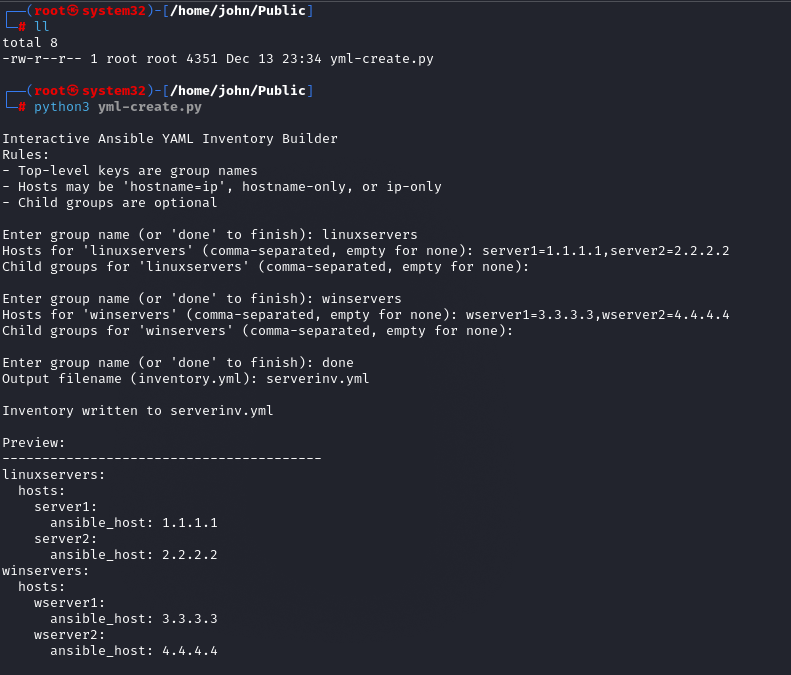
Execution Demo
Running the script and generating an inventory:
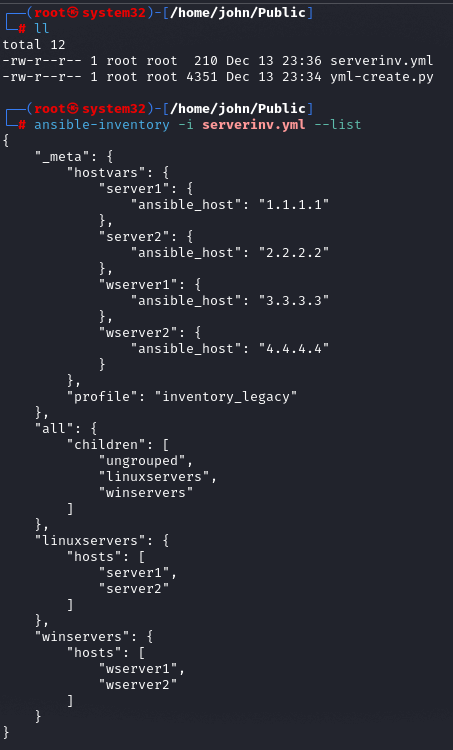
Verifying the generated inventory with Ansible:
Conclusion
This lightweight tool makes Ansible inventory creation fast, error-free, and repeatable—ideal for
airgapped setups or quick prototyping. Save as yml-create.py, make executable if desired,
and start building inventories effortlessly.